
Someone at work was extolling the virtues of her TENS unit for the relief of pain. I was doing floor exercises to work on my neck pain, and they worked intermittent and temporarily, so why not use electrical shocks to get the same effect?
Besides, ten years ago they’d used it to some success when I went to the physical therapist for my frozen shoulder, and I often extend my arm over my head just to revel in my recovery.
So I bought this fancy little home TENS thing for about $36.
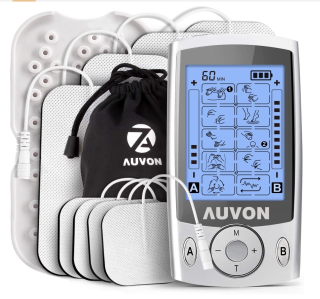
Gary saw it and said, “Why did you buy that? We have one of those already. I got it for my back pain.”
And he actually found his Secret Naughty TENS unit tucked in a bookshelf.
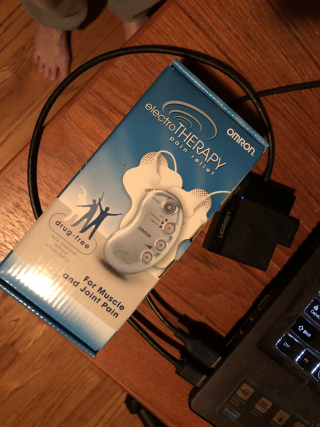
“Then why don’t you ever use it?” I asked. He claims it came with acupuncture attachments and the needles stabbed him when he had the device lying exposed in a drawer. (More likely, he read the directions that people with epilepsy should not use it.)
So now I could get totally amped up with eight electrodes all at the same time. Not that I would — I used it and it was an effective distraction, but even at the lowest setting it was almost too much for me. But then again, I hear you build up a tolerance. I didn’t jump like a frog the second time I used it, but I put everything on differently. Clearly I need to do more research.
All things said, I don’t turn up my nose at the placebo effect.
6 responses to “TENS”
If you find one with a slightly lower lowest setting and that works, I would be Very Interested. My PT accidentally hooked mine up to the muscle that, if I tense it, I can pop my shoulder out of its socket and the TENS pulse activated that muscle and oops. (my shoulder doctor said that she’d never heard of a TENS unit doing that, so: not something to be worried about, my body is just extremely weird) But it was otherwise nice and I’m sure one could avoid that muscle when placing electrodes!
KC – how horrifying! What did the PT do?
Basically the same: oh, that shouldn’t have done that, therefore we will not pursue doing TENS on your shoulders. Confused, semi-apologetic, semi-defensive in tone?
Fundamentally, these shoulders proved to be more squirrely than the PTs were ready for, as repeated at-PT dislocations indicated, but some of the exercises learned have been useful when done at home with a lot of attention to keeping the shoulders in place! But… yeah. My conclusion is that people with extreme hypermobility need PTs who understand extreme hypermobility, and they are hard to find… (It is possible that it would work if the PTs weren’t familiar with extreme hypermobility, but could understand physics. PTs who would work out the physics of an exercise to figure out whether it’s putting the sort of force on the socket that will likely dislocate it, that would have been nice…)
KC – isn’t hypermobility a fibromyalgia thing?
There’s a lot of overlap between “people with collagen disorders” and “people with mystery illnesses” (or certain autoimmune disorders) – I’m not sure how much of the overlap for fibromyalgia is causality and how much is correlation. (some collagen/symptom things for some illnesses are definitely causal: inappropriately over-stretchy collagen in blood vessels directly contributes to blood pooling; skin that has bad collagen is easier to tear; this sort of thing, but I don’t know enough about fibromyalgia to know which things have been IDed as causal vs. fibromyalgia or EDS doctors each saying “oh, yeah, we see a lot of that.. .” about the other thing)
KC – I would not like that.