This week the vase painting went from this:
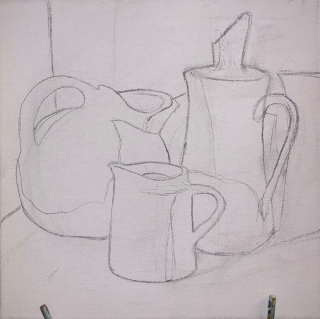
to this:
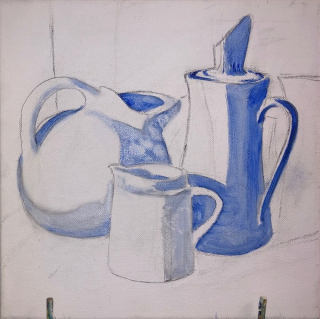
And man, this glazing is going to be slow, because every layer has to dry for a week. I am going to hate these vases so so much.

Putting the TMI in absentminded
This week the vase painting went from this:
to this:
And man, this glazing is going to be slow, because every layer has to dry for a week. I am going to hate these vases so so much.
12 responses to “Weekly Paint Progress: 12/26/2019”
Can you alternate quicker painting projects with the vases during the glaze-drying time? I do a lot of project-alternation to reduce boredom/frustration with necessarily-slow-moving things – then you can see that yes, progress is being made on the Slow One, but you also don’t put off the “ah, finished” or “finally, that stage done” feelings *entirely* for the duration of the Slow One.
KC – I think I’ll get some photos I can practice with, and do some opaque bases I can then glaze over.
That sounds good – do a few where the glaze-that-takes-forever-to-dry is only a minor component, but where it is a component so you get additional practice with it.
(which now has me wondering whether you can actually oil paint *on top of* photos. Probably not; the photo probably falls apart, yes? But it’d be fun if you could just layer on top of a photo…)
KC – in the 1940s, my mother’s sister tinted all the family’s black and white portrait photos. I don’t know if she used oils, pastels, or dyes.
According to Project Gutenberg, a scam “work at home” operation sent you watercolors to colorize photos. (for a price, they send you the “starter” set and have you return the sample photo once you’re done with it; then they say “oh, good job, but you probably need better paints, which we can sell to you for the low, low price of…”)
And “enlarged crayon portraits” were normal-ish, where they enlarged a photo and then went over it with what sounds like pastels to make a portrait sized for hanging on the wall.
But modern photo-printed photos dissolve under some materials (although I suppose one could use a laserjet printing on heavy cardstock?), and oil paintings usually use a pre-prepped canvas rather than paperstock, yes? (but I don’t know if that’s mostly just “custom” or whether it’s a practical necessity due to the paints destroying paper!)(but if cardstock *could* hold up to oil paint glazes, colorizing with oil paint glazes could be fascinating!)
KC – I hope Aunt Dolores didn’t fall for the scam. Oil paintings usually go on some type of canvas – something with a weave, so there are nooks and crannies for the paint to settle in.
That makes sense – so the paint doesn’t just peel/flake off?
KC – if you remember to make the first layer oil-free and the later layers oily and elastic, no it does not.
The first layer has to be oil-free even though there are nooks and crannies on the canvas? (I think this paint type is too complex for me!)
KC – well, the first layer should have no added oil. (There’s oil in the tube.) The later layers need to be even more oily and elastic.
That is fascinating. Can they be exactly the same level of oily and elastic as the first, or does it definitely need to be *more* because “the same” results in cracking/peeling? (materials layering of things that dry/cure/change is *weird stuff*)
KC – You’ve got it on all counts. It has to be more because of drying and cracking. Of course, everything dries and cracks given enough time.