
The Apple Watch had something to report this morning.
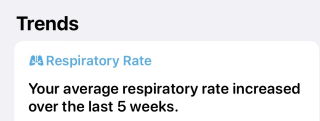
This does not surprise me, given that, as I say, I’ve been panting with desire every waking moment. What did surprise me was that it’s been going on for five weeks. I’ve only noticed it for about three or four.
I dove deep into the data. Turns out that the watch doesn’t judge how I pant every waking moment; it only cares about how I breathe in my sleep. Normal is 20 breaths a minute, today I was 19-26 breaths per minute. And Saturday I got up to 35. For one hour. And that hour was between 8 and 9 pm. Half an hour into Act 1 of the Susannah opera. I don’t why it tracked that: I wasn’t asleep. Perhaps it was the excitement of the opera and the crowd.
I think it’s a new application and there are bugs. Still, even if I throw out the outliers (the opera night and the night I breathed only 7 times in an minute), I still have a rate where the “normal” 20 breaths per minute is my bare minimum. and I cap out at 3o.
I suppose I could be having sex dreams when my rate goes up. I don’t know. Probably a hypochondriac red herring.
2 responses to “Why, Yes, I Noticed That Too”
New types of data can be deceiving, since “average” is a little less normal than would be expected when you’re talking about some functions of human bodies (breathing especially!), and since the methods of detecting the new type of data can be questionable.
But sometimes there’s something actual there. and other times there isn’t. and sometimes it looks like there is, but you can’t figure out what it is or what it correlates to. (have I been taking HRV data nearly every night since 2019? yes. Is it theoretically supposed to correlate to autonomic nervous system function? Yes. Have I figured out how it matches up with symptoms, either past or predictive? No.)(I mean. Heart rate variability does do some specific things *when I am in a lot of pain while taking the readings* but, I mean, I can get that from my heart rate being higher just by itself? This is not as useful to me as something that either meaningfully quantifies more nebulous issues or predicts how the body will be doing the next day to a degree.)
Anyway. Don’t let it drive you mad. (or madder, perhaps) But it might eventually shake out to being useful, especially if you can use the data to breathe more deeply (at least when air quality is not Bad)? (assuming breathing more deeply is not contraindicated for you for some reason) But 1. assume new measurement methods are buggy, and 2. assume different bodies are more variable than averages are [esp. if the average is for all ages!], and 3. assume that individual bodies also have a ton of variation based on various states [asleep, awake, exercising, engrossed] and stimuli of various kinds. May the data serve you well, eventually
KC – well of all my symptoms this one is certainly the least disruptive. And maybe extra breathing at night is a sign of health?